
|
 |
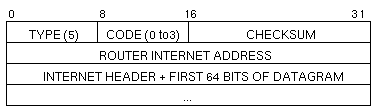 |
| ICMP time exceeded message format. A router sends this message whenever a datagram is discarded because the time-to-live field in the datagram header has reached zero or because its reassembly timer expired while waiting for fragments |
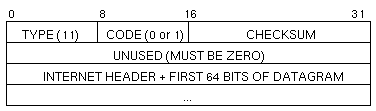 |
| type | 1 | octet |
| code | 1 | |
| checksum | 2 | |
| optional | var |
| Code Value | Meaning |
|---|---|
| 0 | Network unreachable |
| 1 | Host unreachable |
| 2 | Protocol unreachable |
| 3 | Port unreachable |
| 4 | Fragmentation needed and DF set |
| 5 | Source route failed |
| 6 | Destination network unknown |
| 7 | Destination host unknown |
| 8 | Source host isolated |
| 9 | Communication with destination network administratively prohibited |
| 10 | Communication with destination host administratively prohibited |
| 11 | Network unreachable for type of service |
| 12 | Host unreachable for type of service |
A block of class C networks (but fewer than 256) is assigned to an organization.
Classless inter-domain routing (CIDR)
OSes supernetting by incorporating the count of contiguous lower class addresses in the network address. (RFC 1519)
if N matches any directly connected network address deliver datagram to destination D over that network (This involves resolving D to a physical address, encapsulating the datagram, and sending the frame.) else if the table contains a host-specific route for D send datagram to next-hop specified in table else if the table contains a route for network N send datagram to next-hop specified in table else if the table contains a default route send datagram to the default router specified in table else declare a routing error |
Compute IP address of destination network, IN; if IN matches any directly connected network address send datagram to destination over that network (This involves resolving ID to a physical address, encapsulating the datagram, and sending the frame.) else
If N equals the network address field of the entry then route the datagram to the specified next hop address |
 |